What will happen to arts and culture over the next decade? Not the optimistic version, and not the dystopian one, but the full range of plausible futures, shaped by the forces actually in play: technological disruption, climate change, shifting patterns of funding and attention, the fracturing of shared public space. Future of Arts and Culture was a participatory foresight exercise designed to map that range — not to predict the future, but to make it more possible to think about, plan for, and act within.
Over 300 participants took part across 204 sessions, contributing 508 factors to a shared model of how the cultural sector might evolve. The platform, built by Noah Raford using Futurescaper, aggregated these contributions into 52 distinct scenarios. The methodology drew on established futures practice while making it genuinely open: participants were not asked to endorse a single vision but to contribute their own knowledge of the forces shaping the field, and to engage with the visions others brought.
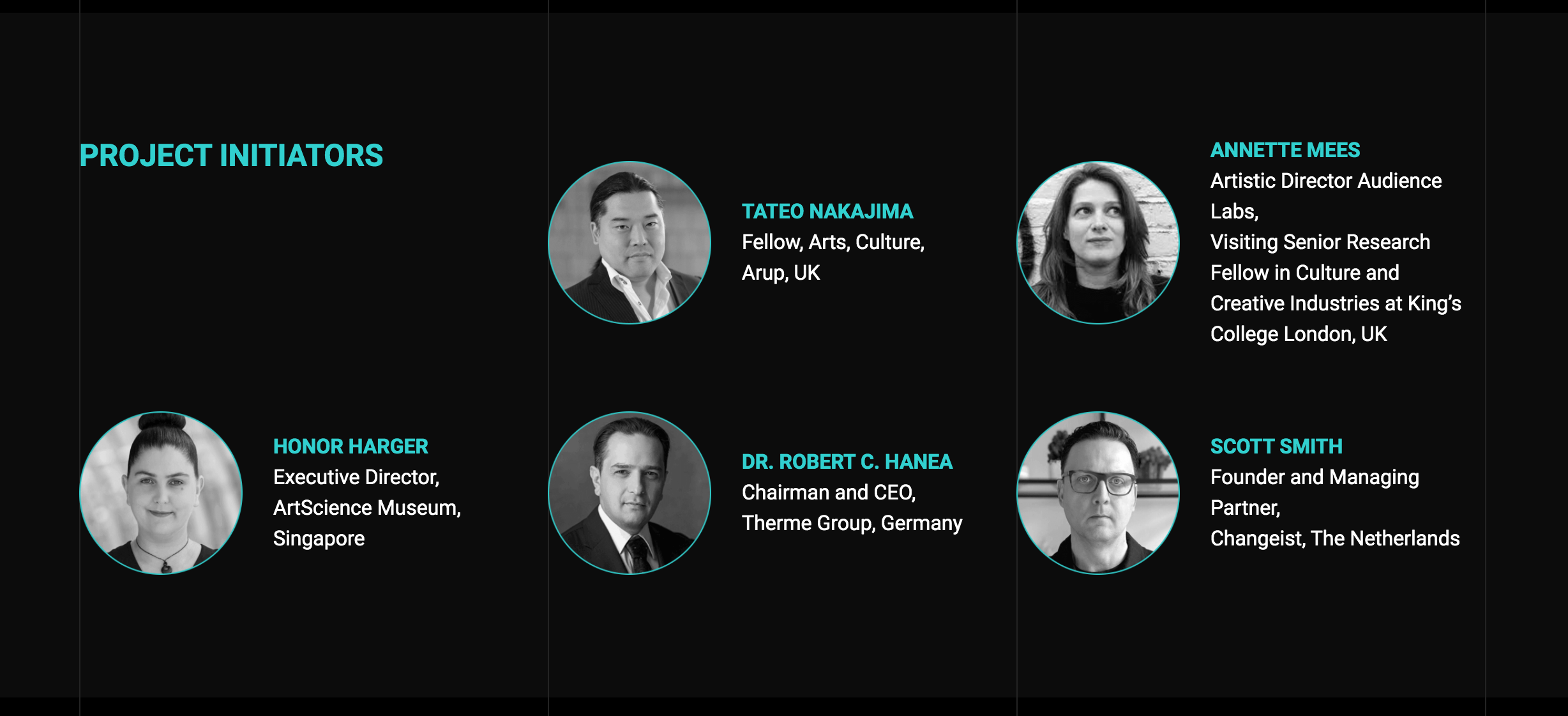
Three broad scenarios emerged from the process: Spectaculars and Small Stages, in which cultural experience polarises between global mega-events and intimate local practice; Global Network of Communities, in which distributed digital networks enable new forms of collective cultural life; and Platforms and Multiverses, in which commercial platforms come to mediate almost all cultural participation. The project was a collaboration between Honor Harger, Annette Mees of King's College London, Tateo Nakajima of Arup, Robert C. Hanea of the Therme Group, and Scott Smith of Changeist.
Team
Honor Harger · Annette Mees · Tateo Nakajima · Robert C. Hanea · Scott Smith
Platform: Noah Raford (Futurescaper)
Scale
300 participants · 52 scenarios · 204 sessions · 508 factors
Three scenarios
Spectaculars & Small Stages · Global Network of Communities · Platforms and Multiverses